

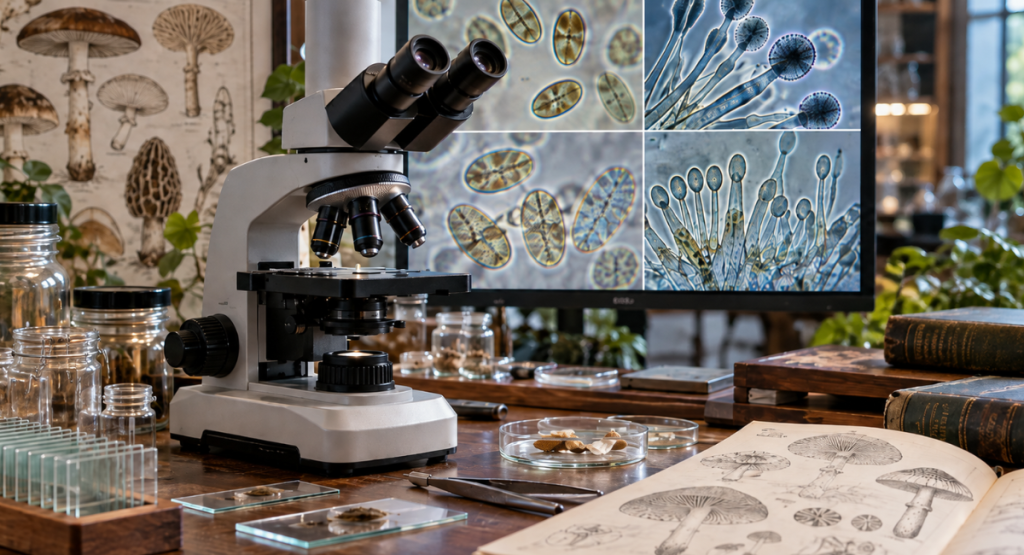
Fungi are incredibly diverse organisms. Even mushrooms that belong to the same species can show small differences in appearance, structure, and inherited traits.
For people interested in mycology, those differences make fungal specimens worth comparing. Microscopy offers one way to examine features that cannot be seen clearly with the naked eye.
By studying spores, documenting physical traits, and comparing specimens, researchers can learn more about fungal diversity and classification.
Genetics is the biological information passed from one generation of an organism to the next.
In fungi, inherited traits help shape characteristics that may differ between species, varieties, or individual specimens. These differences are part of the natural variation found throughout the fungal kingdom.
Genetics can also help scientists understand how closely different fungi are related.
Modern fungal classification often combines visible characteristics with microscopic observations and genetic research. Modern genomics and phylogenetic research have also changed how scientists understand relationships across the fungal kingdom.
DNA itself is not something you can identify with a standard microscope.
What you can observe are the physical characteristics of a specimen.
Spores can vary in several ways, including:
These features are known as morphological characteristics.
When carefully documented, they can provide useful information for comparing specimens and studying fungal taxonomy.
Morphology refers to the form and structure of an organism.
In mycology, spore morphology has long been used as one piece of the identification and classification process.
Some spores appear smooth, while others have textured or ornamented surfaces. They may be round, oval, elongated, or irregular in shape.
Their dimensions can also vary.
These characteristics do not always identify a species on their own, but they can provide useful evidence when combined with other information.
It is easy to confuse genetics with morphology, but they describe different things.
Genetics refers to inherited biological information.
Morphology describes observable physical characteristics.
The two can be related, but they are not interchangeable.
A researcher might compare the appearance of spores under magnification while also reviewing what is known about the specimen’s classification or lineage.
Looking at several types of information together creates a more complete picture.
Variation is normal in biology.
Two specimens belonging to the same general group may not look exactly alike under magnification.
Researchers may notice differences in:
Some differences may be minor. Others may help distinguish one specimen from another.
Accurate notes and photographs make these comparisons more useful over time.
Lineage describes the historical or biological relationship between organisms or specimens.
In a research collection, lineage information can provide useful background about where a specimen came from and how it has been identified.
Good records may include:
Keeping this information organized makes later comparisons much easier.
Microscopy allows researchers to study details that are too small to see without magnification.
When examining fungal spores, researchers may document their appearance, take measurements, capture photographs, and compare those observations with published references.
This kind of work can support broader subjects such as:
Microscopy is only one part of mycology, but it can reveal details that would otherwise remain hidden.
Taxonomy is the science of naming and classifying living organisms.
Fungal taxonomy can be complicated because different species sometimes look very similar from the outside.
Microscopic characteristics provide another layer of information.
Researchers may compare spore shape, dimensions, surface features, and other structures alongside established taxonomic references.
Genetic and phylogenetic research has also changed how scientists classify fungi, sometimes revealing relationships that were not obvious from appearance alone.
Careful documentation is one of the most valuable habits in microscopy.
A simple research record can include:
Using the same format for each specimen makes comparisons easier.
It also creates a record that can be reviewed later instead of relying on memory.
Reliable observation begins with clear identification and good documentation.
Researchers may look for specimens that include:
Accurate labeling is especially important when comparing multiple specimens.
Without it, even detailed microscopic observations can lose much of their value.
The fungal kingdom contains an enormous amount of biological diversity.
Studying inherited traits, microscopic structures, and taxonomic relationships helps researchers understand that diversity more clearly.
A single observation may seem small, but careful records collected over time can reveal patterns between specimens.
That combination of observation, comparison, and documentation is one of the foundations of mycology.
Fruity Spores provides mushroom spore specimens intended for microscopy, taxonomy, collection, and mycology research.
Whether you are comparing spore morphology or building a research collection, careful observation and accurate records can make the experience more meaningful.

